Skip to content

engflow

EngFlow is a Cursor Origin launch partner

Bazel makes your builds correct and reproducible. Making them fast, and keeping them fast as your codebase and your team grow, is a different problem. It's the very problem that EngFlow was created to solve. Our team spent years on the adoption side of Bazel, helping companies put it into production, contributing and creating Bazel's core features, and the pattern is almost always the same: teams love what Bazel does for correctness, then run straight into what it costs to operate for speed.

Today, that's much easier to reach. EngFlow, the platform that runs the largest managed Bazel fleet in the world, with over 3 billion build and test actions every week for teams like Arm, Databricks, and Canva, is now one install away for every team on Origin. Read more about this in Origins's announcement on X (Twitter) and Linkedin.
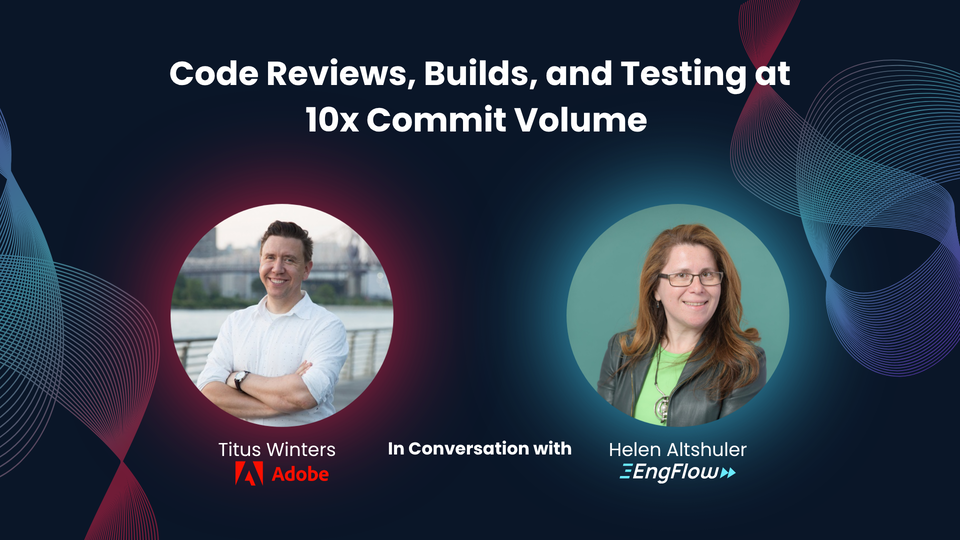
Why Tests Became the Product: A Conversation with Titus Winters

A conversation with Titus Winters · Notes From The Fleet series

Watch the full interview

I sat down with Titus Winters to talk about developer experience and infrastructure at scale. Titus co-wrote Software Engineering at Google; he is now a Senior Principal Scientist at Adobe. I expected a conversation about build systems. What I got was a line I've been thinking about ever since:

"The question is not what can you build with an incredibly fast, 80% accurate tool. It's what can't you build with an infinite army of incredibly fast, 80% accurate tools."

An infinite army of 80% accurate tools. That army doesn't have a code generation problem. It has a verification problem. Whether it helps you or buries you depends on the systems that check, integrate, and maintain everything it produces.

Titus Winters interview

Titus Winters on the shift from code generation to verification in the AI era

Engineering Developer Tools at Scale: London Build Meetup

EngFlow and Deliveroo (a DoorDash company) recently co-hosted a Build Meetup at Deliveroo's London offices. The event came together thanks to Matt from Deliveroo's engineering management team and Vaibhav from EngFlow, who brought together engineers from Deliveroo, EngFlow, Jane Street, and the local build community.

While talks spanned Bazel, Buck2, and Dune, a central theme emerged: as enterprise codebases grow past tens of millions of lines, the main bottleneck moves from writing code to testing and packaging it.

Here is a breakdown of the three technical presentations from the event.

Over 3 Billion Actions per Week: A Year Inside the World's Largest Bazel Fleet

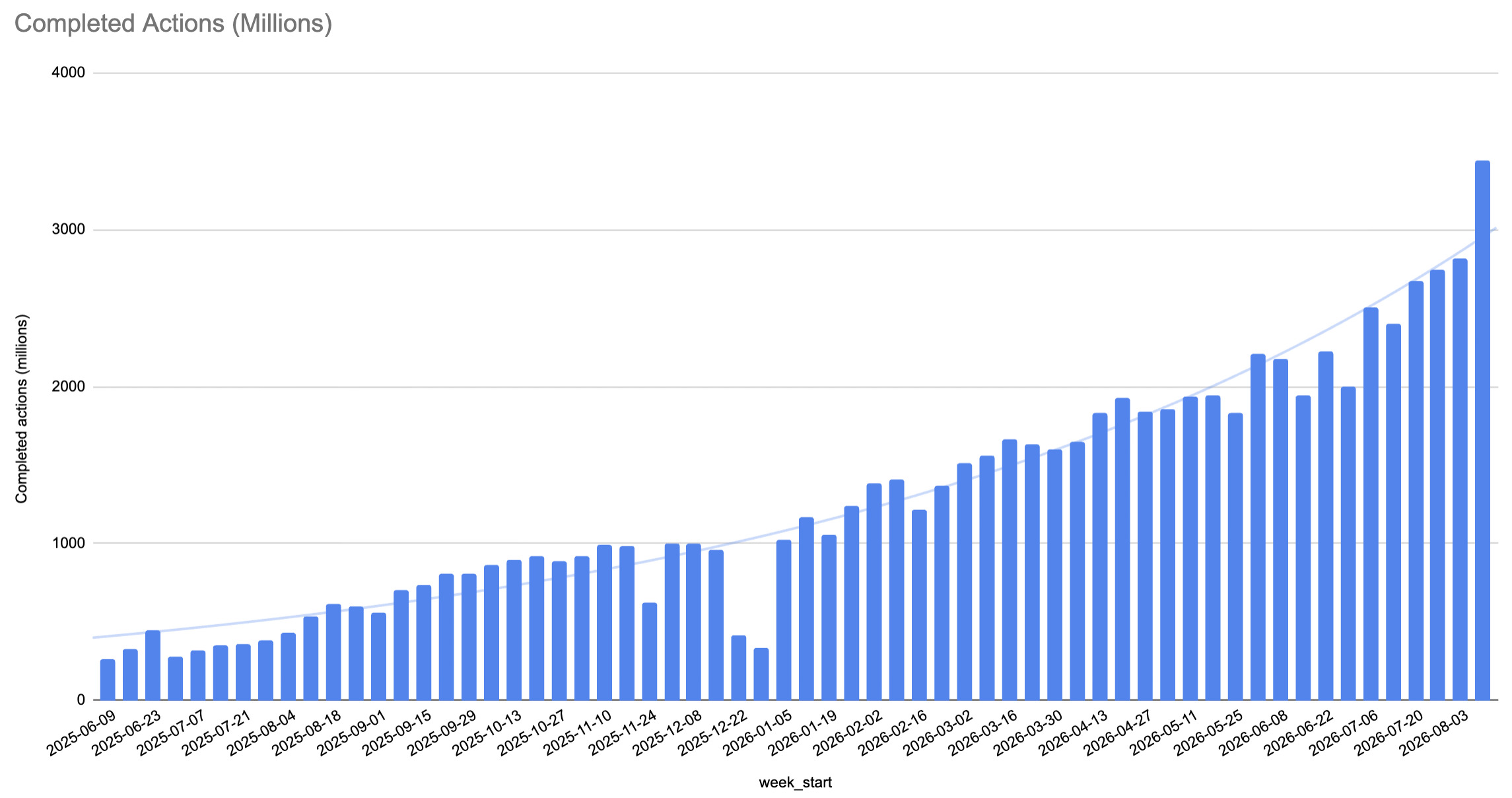
The EngFlow fleet just crossed 3.5 billion actions processed per week. Fourteen months ago, that number was 250 million. That's roughly 14x growth in 14 months.

This isn't a vanity metric. It's a signal of the developer efficiency our platform enables, and of the scale at which we now operate, managing some of the world's most complex and demanding platform engineering workflows for enterprises including ARM, Asana, Block, BMW, Canva, Databricks, Plaid, and Zoox.

14x growth in build actions

14x growth in 14 months in build actions per week across the EngFlow fleet.

Four War Stories and a Demo: Seattle Build Meetup 2026

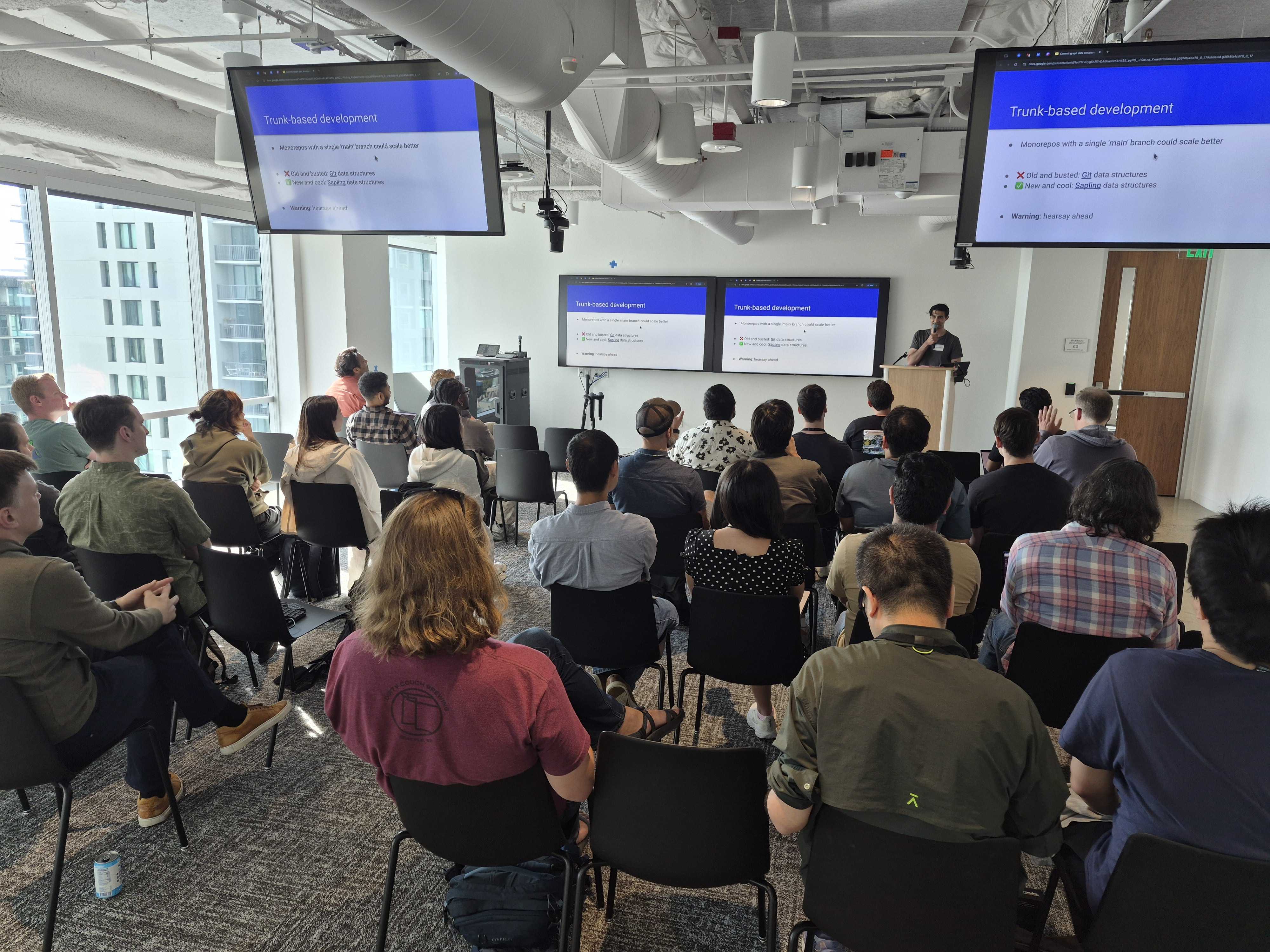
Waleed Khan from Stripe presents in Seattle at Uber’s offices

On July 28, 2026, Uber and EngFlow co-hosted a Build Meetup at Uber’s Seattle office. This wouldn’t have been possible without the help of Sergey Balabanov at Uber, who not only presented one of the talks, but also energetically arranged and helped support this event from the Uber side. Thanks again, Sergey!

And, even though nobody planned a theme for this particular meetup (our meetups are holistically focused on “Build, Scale, Investigate”), one showed up anyway. Code is getting cheaper to produce. Uber put it flatly: “AI is a problem, apparently.” Every talk examined some part of the machinery that turns abundant code into software you can trust. Let’s take a look!

From Prototype to Production: The EngFlow Build Analytics Journey

Every build tells a story. Which targets took the longest? Where did cache misses cost you minutes? Who triggered the invocation, and what source changes drove it? At EngFlow, we believe that surfacing these answers — automatically and at scale — transforms build optimization from reactive firefighting into proactive engineering. Today, we're sharing how our build analytics platform evolved from early prototypes to a production-grade system providing tangible value to our customers.

Iterable cuts P90 build time from 42 minutes to 17 minutes with EngFlow

By migrating its Scala backend from sbt to Bazel with EngFlow and VirtusLab, Iterable created a faster, more reliable build foundation for AI-era engineering velocity.

42 → 17 minutes
P90 build time

~3 minutes
Common build time for smaller changes

~97%
Integration-test pass rate on master, up from the 70s

Iterable is an AI customer engagement platform trusted by global brands to create personalized experiences across every channel. Behind the platform is a distributed engineering organization building and operating a large, complex software estate.

For Iterable’s Developer Platform team, the mission is straightforward: help developers release software faster, with greater reliability and safety.

Build Forensics: How we uncovered a Rust HTTP/2 bug

Last year, one of our customers began reporting that 5% of their jobs based on Meta's Buck2 build system were failing. Even though there was no simple way to reproduce the phenomenon, all signs pointed to network hangs when a Buck2 client made API calls to their EngFlow cluster. If a simple timeout was added, the request would quickly time out, potentially indicating the issue was a bug in our remote execution platform.

Because of the potential for it to expose a broader issue in our software, especially in terms of compatibility issues with Buck2, we elevated the urgency of this investigation. After examining a few thread dumps that revealed nothing conclusive, we eventually scheduled a call with the customer. After performing multiple tests, it became evident that our schedulers were simply idle. If it were truly a problem in our system, we were unable to find evidence.

The Case of the Irregular Hanging: A build forensics story from the front lines of remote execution

There is a particular kind of failure that senior infrastructure engineers recognize immediately. Nothing crashes. Nothing spikes. Nothing logs an error. And yet… work simply stops.

This is the story of one of those failures and why Build Forensics matters once build systems become production infrastructure. For an in-depth technical investigation see this engineering blog.

Democratizing Build Scalability: Eugene Yokota on Bringing Bazel Features to sbt 2.0

In this interview, Eugene Yokota—a software build expert who spent years maintaining Scala's sbt tool at Lightbend before working with hyperscaled Bazel monorepos at Twitter and Netflix—details his multi-year project to build a Bazel-compatible remote caching system into the newly released sbt 2.0. He explores the mechanics and benefits of Bazel, such as its robust remote caching and test cycle speed, and highlights how these modern, scalable build tools can eliminate CI bottlenecks for growing teams while protecting toolchain security.